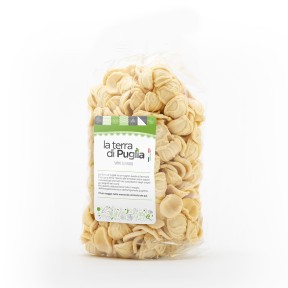
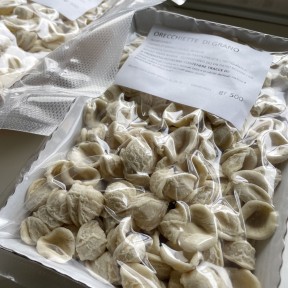
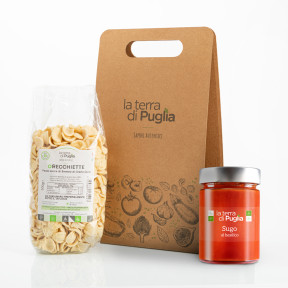
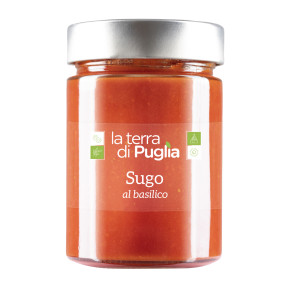
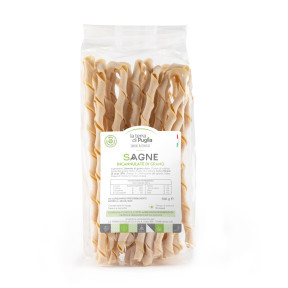
Dried orecchiette made with durum wheat semolina, the signature pasta of Puglia: a rough surface and a cupped shape that hold every sauce. In a 500 g pack, to try with turnip tops, a meat ragù or a simple tomato sauce.
DURUM WHEAT semolina (Country of origin of the wheat: Italy, Country of milling of the wheat: Italy), water.
Nutritional info
Average values per 100 g
Energy 1486 kJ / 355 kcal
Fat 1.6 g
– of which saturates 0.2 g
Carbohydrate 73 g
– of which sugars 2.1 g
Fibre 2.3 g
Protein 11 g
Salt 0.1 g
Cooking time
11-12 minuts
Varietà di grano
Grain semolina
Tipologia di pasta
Orecchiette
Short production line / 0 Km
Si
Specific References
EAN13
8053689162493
Description
🍝
Semolina Orecchiette
“The little ear of Puglia, queen of first courses.”
Dried orecchiette made with durum wheat semolina: the classic shape of Puglian pasta, with a little hollow that gathers every sauce.
Durum wheat semolinaDried pasta500 g pack
Orecchiette are one of the most representative pasta shapes of Puglian cuisine, loved for their unique shape and for the way they bring out any sauce. The name comes from the shape itself, which looks like a little ear. The traditional recipe is simple: durum wheat semolina and water.
These are the classic orecchiette, dried, made with durum wheat semolina. Semolina gives the pasta a rough texture that holds sauces well, and the cupped shape gathers them down to the last bite.
In the kitchen
How to serve orecchiette
🥬
With turnip tops
The most famous first course of Puglia: pasta with turnip tops (cime di rapa), garlic, extra virgin olive oil and anchovies. If you can't find turnip tops, broccoli work too; or try the turnip tops cream.
🥩
With meat ragù
Orecchiette with ragù are a Sunday classic: rich and full of flavour, with a slow-cooked meat sauce.
🍅
With tomato
With a simple tomato sauce, perhaps finished with grated pecorino or another local cheese.
🥦
With vegetables
With a vegetable-based sauce: the hollow of the orecchiette gathers it all.
The tradition
How orecchiette are made by hand
Made at home, orecchiette take skill and patience. The dough of durum wheat semolina and water is kneaded for a long time, until it becomes elastic and firm; then it is divided into small pieces, which are shaped with the thumb or a knife, pressing and dragging them across the pastry board.
That gesture creates the typical rough surface, and it is why in Puglia orecchiette are also called «strascinate» (dragged). A technique handed down from generation to generation: in Puglia there is no Sunday without homemade pasta, and if it's orecchiette, even better.
The history
Where do orecchiette come from?
Orecchiette have ancient origins and are typical of Puglia, in particular of the Bari area. The first records date back to the Middle Ages.
There are two theories about how they were born. According to one, they were brought by the Normans during their rule in southern Italy, inspired by a similar pasta made in Provence. According to the other, orecchiette evolved from the typical pastas of southern Italy, made with simple, local ingredients.
Other shapes
Orecchiette, strascinati and other Puglian pasta
The difference between orecchiette and strascinati lies in the shape and in how they are made. Orecchiette are small and cupped, with a rough surface. Strascinati, typical of Puglia and Basilicata, are made in a similar way but are larger, with a longer, more irregular shape; their name also comes from the verb «strascinare», to drag, the movement used to shape the dough.
Puglian tradition also has cavatelli, with a hollow inside for thick sauces, maccheroni and tria, the pasta of «tria e ceci», an old recipe from Salento loved all over the region: fried pasta served with chickpeas. Other Sunday first courses are the Puglian lasagna, with little meatballs and cheese, and cavatelli and strascinati with fish or pulse sauces.
How it's made
How dried pasta is made
Dried orecchiette are made in five stages, from choosing the raw material to packing.
1
The raw material
The quality of the durum wheat semolina is decisive: it is checked before it goes into production.
2
Hydration and kneading
The semolina is kneaded with cold water: a step that takes skill and experience to get the dough just right.
3
Mixing and shaping
The dough is worked further until it is smooth and elastic, then goes into the shaping machines with their dies, which give the pasta its form.
4
Drying
Freshly shaped pasta is still moist and would not keep: it has to be dried gently, to preserve its qualities.
5
Resting and packing
After drying, the pasta rests in a controlled environment to stabilise, and is then packed.
Prodotto molto buono. Cottura come da minuti indicati
Reply from the shop Ci fa piacere che le orecchiette di semola le siano sembrate molto buone e che la cottura indicata sia risultata giusta. Grazie per la segnalazione.
Il team La Terra di Puglia
Verified buyer
in French
Très bonne, on a retrouvé le goût des pâtes fraîches que nous faisait la Mama 😊
Reply from the shop Retrouver le goût des pâtes fraîches de la Mama, c'est le plus beau des compliments pour nos orecchiette. Merci de tout cœur pour ce message.
L'équipe La Terra di Puglia
Verified buyer
in Italian
Perfette, mi ricordano quelle fatte da mamma.
Reply from the shop Ritrovarci le orecchiette di mamma è un ricordo prezioso, e siamo onorati che le nostre glielo abbiano riportato. Grazie per queste parole.
Il team La Terra di Puglia
Verified buyer
in Italian
Prodotti ottimi e di qualità! Puntualità e servizio perfetti! Consigliatissimo!
Reply from the shop Qualità delle orecchiette, puntualità e servizio: tre complimenti che ci incoraggiano molto. Un grazie sentito per il consiglio così convinto.
Il team La Terra di Puglia
Verified buyer
in Italian
Tutto buono, prodotto impeccabile e di alto livello
Verified buyer
in Italian
C'è poco da raccontare...: è tutto BUONISSIMO...!!!
Reply from the shop Quando c'è poco da raccontare perché è tutto buonissimo, va benissimo così. Grazie per l'entusiasmo verso le nostre orecchiette.
Il team La Terra di Puglia
Verified buyer
in Italian
Ottima fattura e di qualità per la farina usata
Verified buyer
in Italian
Prodotto ottimo, lo consiglierei provare per credere
Reply from the shop «Provare per credere» è il miglior invito che si possa fare per le nostre orecchiette di semola. Grazie per averlo rivolto ad altri clienti.
Il team La Terra di Puglia
Verified buyer
in Italian
molto buone davvero! Tengono bene la cottura
Reply from the shop Che le orecchiette tengano bene la cottura è proprio ciò che si chiede a una buona pasta. Grazie per averlo notato e condiviso.
Il team La Terra di Puglia
Verified buyer
in Italian
Ottimo prodotto della tradizione pugliese.
Verified buyer
in Italian
Ottimi.....................,,.,...............
Verified buyer
in Italian
Prodotti veramente eccezionali e creati con vero amore per i palati raffinati. Dovrebbero essere esportati in tutte le regioni e nel mondo.
Verified buyer
in Italian
Prodotto artigianale, tiene bene la cottura.
Verified buyer
in Italian
Prodotti buonissimi e consegna più rapida del previsto. Ordinerò sicuramente altro in futuro
Verified buyer
in Italian
Ottime con il sugo fatto con la vostra salsa di pomodoro
Verified buyer
in Italian
Finalmente le vere orecchiette pugliesi. Eccellenti
Verified buyer
We also publish critical reviews, and we only ask customers who have received an order. Reviewers then get a thank-you voucher, the same whatever the rating. How we collect reviews
 Italiano
 English
 Français
 Deutsch