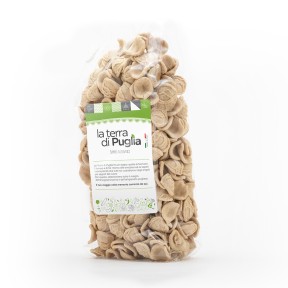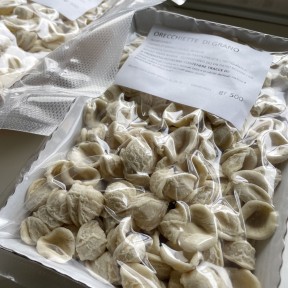
Dried orecchiette made with whole durum wheat semolina: Puglia's signature pasta in a whole wheat version, with a rough surface and a little cup that holds the sauce. In a 500 g pack, perfect with turnip greens, fresh tomatoes or a meat ragù.
DURUM WHEAT semolina 50% (Country of origin of the wheat: Italy, Country of milling of the wheat: Italy), wholemeal DURUM WHEAT semolina 50% (Country of origin of the wheat: Italy, Country of milling of the wheat: Italy), water.
Nutritional info
Average values per 100 g
Energy 1502.3 kJ / 354 kcal
Fat 1.8 g
– of which saturates 0.6 g
Carbohydrate 71.5 g
– of which sugars 3 g
Fibre 1.6 g
Protein 12.2 g
Salt 0.1 g
Cooking time
11-12 minuts
Varietà di grano
durum wheat
Tipologia di pasta
Orecchiette
Short production line / 0 Km
Si
Specific References
EAN13
8053689162516
Description
🌾
Whole Wheat Orecchiette
“Puglia's little ears, made with the whole wheat grain.”
Dried orecchiette made with whole durum wheat semolina: smooth inside, rough outside, and a little hollow that catches every sauce.
Whole durum wheatDried pasta500 g pack
Orecchiette are the traditional pasta of Puglia, easy to recognise by their shape of a little ear — which is exactly what the Italian name means. Made by hand, each one starts as a small piece of dough pressed with the thumb into a hollow that holds sauces perfectly. The traditional dough is simple: durum wheat flour, water and sometimes a pinch of salt.
These are orecchiette in their whole wheat version, made with whole durum wheat semolina. They keep everything that makes orecchiette special — the cupped shape, the rough surface that grips the sauce — and add the full flavour of whole wheat.
The tradition
Orecchiette or «strascinate»
Orecchiette come from Puglia's ancient culinary tradition. There they are also called «strascinate» (“dragged”), because home cooks drag them one by one across the pastry board with the thumb or with a special round-tipped knife. The result is a shape that is smooth inside and ridged outside, and it makes every dish full of flavour.
Making them by hand takes skill and a lot of patience. Every family in Puglia has its own recipe and technique, handed down from generation to generation: orecchiette are not just a dish but a piece of the region's culture and history, now loved all over Italy.
In the kitchen
How to dress whole wheat orecchiette
🥬
With turnip greens
Puglia's most famous dish, simple and full of flavour: with fresh turnip greens (cime di rapa), or with our turnip greens cream.
🍅
Alla crudaiola
With fresh tomatoes, mozzarella and basil: one of the best-loved orecchiette sauces, perfect in summer.
🥩
With meat ragù
For a bolder taste, a meat ragù or a rich, full-flavoured tomato sauce.
🥦
With seasonal vegetables
Vegetable-based sauces, depending on what the garden offers: the hollow of the orecchiette gathers them all.
⏱️
When time is short: a sauce of cherry tomatoes and basil, or a dressing of broccoli and anchovies. Both are ready in a few minutes and bring all the flavour of tradition to the table.
The wheat
What is the difference between whole wheat pasta and durum wheat pasta?
The difference lies in the flour. Whole wheat pasta is made with whole wheat flour, which contains every part of the wheat grain: the bran, the germ and the endosperm.
Classic durum wheat pasta is made with refined semolina instead: during milling the bran and the germ are removed and mainly the endosperm remains. That is why it has a smoother texture, while whole wheat pasta is more rustic.
How it is made
From semolina to pasta
Dried orecchiette are made in five stages, from choosing the raw material to packing.
1
The raw material
The quality of the durum wheat semolina is decisive: it is checked before it goes into production.
2
Hydration and kneading
The semolina is kneaded with cold water: a step that takes skill and experience to get the dough right.
3
Working and shaping
The dough is worked further until it is smooth and elastic, then goes into the shaping machines, whose dies give the pasta its form.
4
Drying
Freshly shaped pasta is still moist and would not keep: it has to be dried gently, to preserve its qualities.
5
Resting and packing
After drying, the pasta rests in a controlled environment to stabilise, and is then packed.
Just like classic orecchiette: with turnip greens, alla crudaiola with fresh tomatoes, mozzarella and basil, with a meat ragù, with seasonal vegetables, or quickly with cherry tomatoes and basil or broccoli and anchovies.
How are they different from semolina orecchiette?
The flour: here it is whole durum wheat semolina, which contains the whole grain, bran and germ included. The pasta has a more rustic texture. The classic ones are our semolina orecchiette.
Why are they also called «strascinate» in Puglia?
Because of how they are made by hand: home cooks drag them one by one across the pastry board with the thumb or a round-tipped knife.
🍝
Puglia, the whole wheat way
The shape of orecchiette and the full flavour of whole wheat: try them with your favourite sauces and find a new way to dress them every time.